Showing posts with label Myind. Show all posts

Onam and Vamana Jayanti — A failed coup by leftist establishment

Every land and culture has its own unique customs and traditions. Kerala, bordered by the Western Ghats on the east and the sea on the west has developed a peculiar system of traditions as well as political behavior different from rest of India. Hailed as the most literate state with a higher rank in HDI, Keralaites tend to look down on the comparatively ‘unschooled’ regions in India. However, I am compelled to say that Malayalees fail to do any soul-searching. A little knowledge is a dangerous thing. One such moment was ruckus on BJP president Amit Shah’s Vamana Jayanti greetings to all Indians and the turmoil triggered by Marxists from Kerala.

The first Onam of the newly elected communist government of Kerala has been smeared with controversy from the beginning of its ten-day celebration The government issued an order to control festivities conducted during office hours. Chief Minister Pinarayi Vijayan had said in a Facebook post that it was not proper to hold Onam celebrations in state-run establishments during working hours.


Since the government has been creating controversies by meddling with Hindu affairs after assuming power, people took it as another nail by the Marxists on the majority community. Meanwhile, they got an opportunity to divert the attention onto their arch enemy Sangh parivar when RSS weekly in Malayalam, Kesari came with the Onam special edition. Kesari had an article describing the story of Vamana avatar as in Bhagavata Purana by a noted Bhagavata Purana scholar. Leftist intellectuals started scaremongering using the depiction of Vamana, the fifth avatar of Lord Maha Vishnu in the article as North Indian hegemony by the Parivar. Someone even accused RSS of ‘Hindutvaization of Kerala’s Onam festival’. Words fail me, what does it mean that RSS is trying to ‘hinduise’ Onam? Isn’t Onam a Hindu festival? Isn’t Hindu, the name of the original culture of the land before Islamic and Christian rulers came?

If we research a bit, the story of Mahabali is associated with the fifth avatar of Lord Maha Vishnu, the Vamana avatar. Vamana means a dwarf. He is also known as Trivikrama and has been worshipped so in various parts of India. He was the son of Sage Kashyap and Aditi. Mahabali was the great grandson of Kashyap and grandson of the great Vishnu devotee Prahlada. King Mahabali performed Vishvajit yajna and conquered all three worlds. As the gods left devaloka, mother Aditi worshipped Lord Maha Vishnu by observing Payo Vrata and hence pleased, Vishnu was born as her child to help Indra and other gods get back the world. Like his grandfather Prahlada, Mahabali also was an ardent devotee of Vishnu. He promised the Brahmin boy who approached him to fulfil his desire. The boy asked for land that can be measured by his three step. With two strides, he covered the whole universe leaving nothing for the third one. Staying truthful to his word, the King humbly showed his head for the boy to measure. As the story goes, Lord Vishnu got pleased by the supreme sacrifice of the King, sent Mahabali to Sutala, one of the lower worlds with all amenities and has promised to make him the Indra during the Savarni Manu’s era. He also blessed King Bali by promising his protection & care from all ailments in Sutala until SravaniManvantara. By being kind to the request of a Brahmin boy, through his selfless sacrifice, King Bali, an Asura attained supreme protection of Maha Vishnu. The moral of the Story of Vamana avatar in Bhagavata Purana is also about the essence of Bhakti, a devotee’s total surrender to the god. Onam in Kerala is believed to be the commemoration of the return of King Mahabali to see his folks. But historically, references to seven days Onam festivities date to the ancient Tamil Sangam text, Nalayiram Divyaprabhandham of Alwar saints. In a feature carried by The Telegraph newspaper in 2013, noted historian and former Chairperson of Indian Council for Historical Research M G S Narayanan confirmed that Vamana was the hero of Onam until the 11th century and that Bali became more popular only after the 16th century. In any case, festivals are not solely based on history. We should also note that the official onam celebrations in Kerala start with the procession called ‘Atha chamayam’ from the headquarters of erstwhile Kochi kingdom to the Vamana Moorthy Temple in Thrikkakkara, Ernakulam. A mandapam exists in the temple representing Mahabali. Even in Hindu homes of Kerala, Onam feast is celebrated by offering sadya (traditional meal) to gods and ancestors before the family eat. Keralites place mud pyramids of Onathappan, in the middle of the Pookkalam (flower carpet ) is made for welcoming Mahabali. Leftists cry foul when someone tells the story of Vamana and Mahabali as it is in scriptures. There have been several legends associated with the identity of the King Mahabali; one such is based on a 16th-century poem written by a poet Sankara Pillai in which Mahabali is a local chieftain loved by the people of central Kerala. Keralites have been singing this song also for decades.

So, what do socialists intend to achieve by creating unnecessary controversies by ascribing Dalit identity to Mahabali as well as native flora? When BJP president Amit Shah wished Vamana Jayanti to all ‘Deshvasiyon’ (people of India) in Hindi, lefties found a golden chance to inflate a divisive regionalist sentiment using Onam festival. They saw this as one more step in their struggle to stop ‘Sangh Parivar’ in Kerala. But they forgot the fact that, Deshvasiyon doesn’t mean Malayalees alone. Also, Vaman Jayanti is a festival observed in states like Madhya Pradesh, Gujarat, etc. on the Dwadasi after the Shukla Paksha (fortnight of the waxing moon) in the month of Shravana (Chingam in Malayalam). In 2014, September 6th was Vamana Jayanthi and September 7th Thiruvonam. In 2015, Thiruvonam was at the beginning of Chingam month (August 28th) per Malayalam Calendar, and Vamana Jayanti fell on September 24th. Since the duration of Ekadasi was short, Dwadasi came early on sep13th and incidentally Thiruvonam of Kerala falls on September 14th. As Shah is the leader of a national party, he cannot consider only one state while writing in Social Media.


On the other hand, the communists have a strong presence only in Kerala, which restricts their knowledge regarding festivals and issues pertaining only to the realm in which they exist. The uproar over Vamana Jayanthi exposes the ‘Koopa mandooka’ mindset of the communists who see everything around them in their worldview. This debate also reveals the utter ignorance of leftists and media about Hindu texts and their perverted endeavors to define Hindu concepts through Semitic jargons. The brouhaha is political opportunism by half cooked ideas on Hindu Puranas acquired from Amar Chitra Katha. Ironically, the same people who have been lobbying to forget the ‘myth’ of Mahabali and exhorted to celebrate onam as a secular harvest festival and boycott ‘upper caste’ sambar and Aviyal and called for the boycott of Onam for it being ‘Shirk’ were desperate to worship ‘Dalit King Mahabali’ now.

Searching opportunity for conflict based on description of the world through Marxist analysis is absurd because Hindus have the freedom to choose whom to worship and how to worship. Hindus are not locked in the closed world of Good vs. evil or black vs. white binary. Hence we can accept Vamana as well as Mahabali with the same fervor. There is a limit to the conflicts, an ideology which failed to nurture scientific temper in countries with monoculture, and monotheistic religions can inflict in an open and diverse society as Hindus. Leftists have a lot to worry, even in the last bastion, you are now revolving around Sangh Parivar.


Originally published in https://www.myind.net/onam-and-vamana-jayanti-failed-coup-leftist-establishment

Sri Lalithasahasranama:The great Stotra and a Treasure of Ancient Knowledge

During, many Hindu temples and homes reverberate with prayers to the mother Goddess. The most well-known prayers chanted during this time include ‘Chandi Paath’ in the North(aka  Durga SaptaShati and Devi Mahatmyam) and ‘Sri LalitaSahasranAma’(LSN) in the South. While the former is also recited in the south,  it’s the Sahasranamam that is ubiquitous.

Sri Lalitha

Sri LalitaSahasranAma literally means the thousand names of Sri Lalitha and is an important text in Srividya. This is from Brahmanda Purana and is a part of Lalithopakhyana or the story of Sri Lalitha and happens in a conversation between the great sage Agatsya and Lord Hayagriva. The Rishis for this stotra are the 8 Vagdevis starting with Vashini(also mentioned in Khadgamala Stotram). Comprising 183 shlokas it contains exactly 1000 names. Its well-known there are no fillers for fitting the meter and no name is repeated in this Stotra.

The goddess Lalitha referred here literally means the ‘playful one’. This entire creation is her play. Starting with the name ‘SrimAtA’, the stotram describes her physical form, her attributes, actions and her grace and also tells her story using just names thereby revealing a comprehensive Tatva of the Devi. This is surely magical when looked at as a work of poetry. It also gives us a lot of knowledge of various subjects mentioned in our ancient scriptures.

Trends

Taking a cursory look at the kinds of names, 27 end in ‘RupA’ and 40 end in ‘rUpini’ indicating she is all-pervading in names and forms. 12 names end in NilayA and 22 end in the suffix ‘sthaa’ if we are interested in where she resides. The word ‘priyA’ comes 24 times telling us what she likes. The suffix ‘dA’(giver) is in 25 names. The prefix ‘ni’ comes around 40 times to guide us what she is not/devoid of (nirupamA, nireeshwarA etc).

Number 5

She is seated on PanchabrahmAsana(nama- Panchabrahmasanasthita) with Brahma, Vishnu, Rudra, Ishwara and Sadashiva forming the legs and the base. The Pancha Brahmas do 5 main important krutyas

When she takes Brahmarupa she is Srishtikartri, as Govindarupini  she is Goptri,  as Rudrarupa- she is Samharini, as Ishwari she is TirodhAnakari, as Anugrahadaa she is ‘sadAshivA’.

In these forms, she is constantly doing creation, sustenance, destruction, obscuring the creation into a beeja form and then liberation (Panchakritya-Parayana).

She pervades the 5 koshas/sheaths (Panchakoshantarasthitaa) that make up the Sthula, Sukshma and Karana Shariras(physical, subtle and causal bodies). The sheaths are Annamaya, Pranamaya, Manomaya, VignAnamaya and Anandamaya.

She is Panchayagnapriyaa- the one who likes pancha yagnas viz. Deva, Pitr, Manushya, Bhuta and Brahma yagnas(worshipping devas, ancestors, humans, all beings and Brahman).  Pancha is a recurring number in LSN. She holds 5 arrows each representing the Tanmatras(the subtle aspects of the primordial elements or panchabhutas) viz. Shabda(space), Rasa(water), Rupa(fire), Sparsha(air), Gandha(Earth). The mother who has these arrows and Manorupa-ikshukodanda(sugarcane bow called mind) surely controls all Prakriti inside and outside us.

LSN starts with describing her form in detail and goes on to subtler aspects.  Towards the middle, she is described as parA, pashyantI, MadhyamA, VikharIrUpA which are the 4 stages of speech.

parA pratyakchitIrUpA pashyantI paradevatA |

madhyamA vaikharIrUpA bhakta\-mAnasa\-haMsikA

She is Gayatri(the mantra) , Vyahriti(the invocations that precede Gaytri) and SandhyA.

She is in the pairs of opposites (Vidya-avidyA swarupini), Chit-shakti and Chetana rupa(consciousness) on one hand and jada Shakti and jadAtmikA(passive and not conscious) on the other. While she is in all forms, she is also ‘nAmarUpa-vivarjita’. While she is triguNAtmikA she is also nistraigunyA.

The various Chakras

Right at the middle of LSN, there is knowledge given on seven Chakras, the seven Dhatus they are associated with and how mother is visualized and propitiated in each Chakra.

Vishuddhi chakranilaya – One head with 3 eyes. Likes Payasa(pAyasAnnapriyA) and is in the Tvak(skin- Tvakshtaa)

anAhtAbjanilayA -2 heads, likes snigdhodana(food with lot of ghee n other fats) is in the blood(rudhirasamsthitaa)

maNipoorAbjanilayA – 3 heads, likes GudAnna(jiggery rice) and is in the maamsa(flesh/muscle)

swadhishtAnAmbuja-gatA – 4 heads, likes dadhyanna(curd rice) and is in medha(fat)

moolAdharAmbujArUDhA – 5 heads, likes mudgodana(khichdi/pongal with moong dal) and is asthi(bones)

AgnAchkarAbjanilayA – 6 heads, likes haridrAnna(yellow rice) and is in majja(marrow)

SahasradalapadmasthA(Sahasrara chakra) – head everywhere, likes sarvaudana(mixed rice) and is in Shukla

She is in the form of IchhAshakti, GnAnashakti and KriyAshakti(The power of desire, knowledge and action);  TrivarganilayA- trivarga meaning Dharma, Artha and Kama and also muktidA. In yoga, TriputI refers to the triad of Knower-Known-Knowledge. She is all three(Triputi EkAkAra) which is revealed by the name dhAna-dhyAtru-dhyeya-rUpA.

Beyond the worldly

Later half of LSN extolls mother as formless and the ultimate. Eg:  SarvopAdhivinirmuktA(devoid all limitations/impositions), KalpanArahitA(devoid of imagination), SatyagnAnAnandarupA(whose form is truth and knowledge). She is also given the name Paramjyotih(a neuter gender noun in Samskritam) and is called ParAtpara(beyond the parA).

LSN is unique in the sense that while extolling the mother, it gives us pointers on how to reach her (BhaktigamyA, dhyAnagamyA), how to pray her (64 upacharas, panchayagnyas, dashamudrAs ) and her mercy for devotees ( bhayApahA, dukhahantrI, sukhapradA). There are also the long but very reassuring compounds like

KarAnguLinakhotpanna-nArAyaNadashAkritih- the one who created the 10 forms of Vishnu from her finger nails.

SamsArapankanirmagna-samudhharanapanditA - The one who is adept at rescuing people who have fallen in the dirt called Samsara.

TapatrayAgnisamtapta-samAhladanachandrikA - Delighting moonlight for the ones who are burning in the fire of tApatrayAs

janmamrityujarAtapta-janavishrAntidAyinI – The reliever of people burnt by janma-mrityu-jarA

nAma sankeertanam is considered the most easy way to reach divine in Kaliyuga. LSN confirms the same in the names -  ‘nAmapArAyaNapreetA’ and ‘StotrapriyA’(She delights in the chants of her name)!!

The Phalashruti aptly says ‘anena sadrusham stotram na bhUto na bhavishyati’( there hasn’t been and there won’t be a Stotra like this).

Originally published in https://www.myind.net/sri-lalithasahasranama-great-stotra-and-treasure-ancientknowledge

Sabarimala temple in the ‘secular’ world

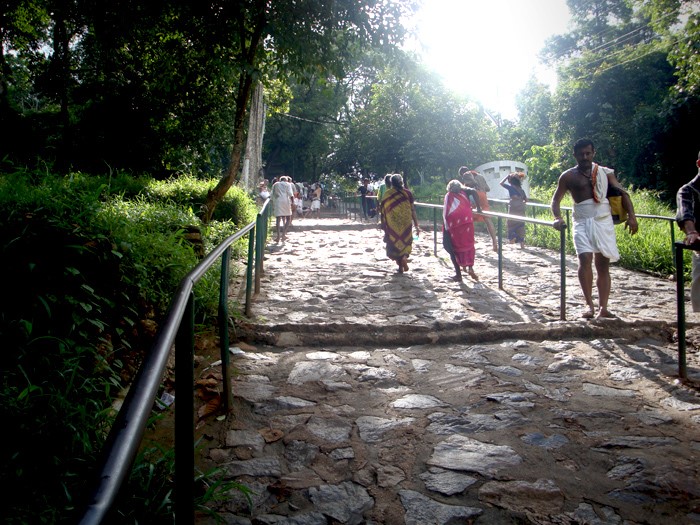
The holy hill of Sabari, Sabarimala, is located amidst the dense jungles of the Western Ghats in Kerala, bordering the state of Tamil Nadu. Vrischikam, the fourth month of the Malayalam calendar (November -December) marks the beginning of the annual pilgrimage to the temple. This is also when devotees observe 'mandala vratham' - 41 days of strict penance to cleanse oneself ahead of the trek to the shrine, through the dangerous jungle path. Such is the devotion that not only pilgrims, but even the faithful who cannot go to the shrine due to reasons like ill health also observe the'vratham'. The popularity of the shrine is an eyesore for the "breaking India forces" and attempts to destroy it have been on since long

The Ayyappa concept

It is not easy to decipher the ‘Devata sa~Nkalpa’( concept of divine deities) of Hinduism. Most of the deities are represented using complex cryptic epithets (paroksha priyaahi iva devah). In Kerala, Dharma shAstA (teacher of Dharma) is worshiped mainly in four places - Kulathupuzha, Aryankavu, Achankovil, and Sabarimala. While in Kulathupuzha, he is in the form of a `balaka’ (child), he takes the form of a 'Grihasthi' (home maker) with wives in Achankovil, and as an old `tApasa’ (ascetic) in Aryankavu. Whereas in Sabarimala, Ayyappa is in the form of a `kumara’ (teenager) observing brahmacharya (literally means pursuit of brahma but in modern times, is interpreted as celibacy). These four pratishtas (installations) denote the four stages of human life – childhood, teenage, family man and old age.

Ayyappa pratiShTha in Sabarimala sits in Arddhasana or Yogapadasana. This posture reveals the mood of asceticism, the tapobhAvaM. The knees are bound by `yogapatta’ (a belt made of cloth) and hands are in yoga mudra. Lord Ayyappa is a Brahmachari and an ascetic, his murti (idol) is made in sitting posture with the legs bent with his knees pointing upwards. Symbolically, this shows that the figure leaves no space for anyone to sit on its lap. Ayyappan in this state elevates one to the conscious awareness (observing) state which is called Sat-Chit-Ananda or meditative state.

With his Chinmudra, gesture of the hand, Ayyappa expounds the meaning of the supreme philosophy `Tat Tvam Asi’ (that art thou – you are that). The vrataM (austerities) is the basis for devotion. Since the deity is in the form of a naiShTika brahmachAri (absolute brahmachari), it is therefore believed to be the duty of every devotee who observes the pilgrimage to follow the vrataM with utmost sincerity and purity like a student who devotes his complete attention to the pursuit of knowledge. Once the believer starts the `Vratham’, he purifies his mind and body to become Ayyappa himself. So much so that he is called a swami thereafter. That’s the whole idea behind the hard and strict observance. Every devotee becomes a ‘Swami/God’ himself and acts as the Supreme Being would. They do this till they remove the rosary (which they don at the beginning of the vratham) from their neck upon return from the temple. The pilgrimage and associated rituals amply illustrate the sanatana dharma concepts of union of jIvAtmA (individual soul) with paramAtmA (supreme soul). This is also the underlying principle of ‘Advaita’, which says the two are not different, but one.

When foreigners, ignorant of the traditions and shAstras, tried to decipher and translate the complexities of India’s systems and customs through a Semitic prism, we lost the sense behind most of the rituals and customs. The secular western education we subsequently acquired somehow made us unable to understand these cryptic epithets (parokSha sa~Nkalpa).


‘Secular’ attacks against Sabarimala

The hugely popular Sabarimala temple has always been the target of interests inimical to Sanatana Dharma. Attacks on the shrine are as old as the ‘secular state’. One such major incident was the fire in the temple on 16th June 1950. The sanctum sanctorum was completely gutted and the deity was broken. An inquiry report by the Special Branch (CID) reportedly concluded that the fire was deliberate and hinted at a Christian angle to the crime. But what was the truth will never be known as governments have till this date shied away from making it public. In fact, the Communist party once even fought the polls on the promise of making it public, but went back on its promise after winning the elections.

The second `attack’ was more recent and came in the form of attempts to construct a church in front of the Mahadeva temple at Nilakkal (on the way to the temple), in the area regarded as Poonkavanam (Garden) of Ayyappa. As is commonly followed by church planters, a Cross was found near the Nilakkal temple on March 24, 1983. Media carried news of the ‘discovery’ of the church claiming it was planted by none other than Jesus Christs’ disciple St Thomas. Christian pilgrims started flowing to the spot. Soon, the road to the temple was named St Thomas Road and the Christians started calling the Nilakkal hill as St Thomas Mount. On May 19, within a month of the discovery, Kerala government approved a grant of 1 hectare of land to build Church in Nilakkal. This was fiercely opposed by Hindu organizations and thousands of believers, who took to protests, were arrested. But the relentless struggle of the Hindus ensured that Church planters had to shift the cross to a new location.

If this was not enough, there are still attempts being made by a section of Leftist historians to portray Ayyappa, who according to Hindu beliefs was the son of Lord Siva and Mohini (Lord Vishnu in female form) as a Buddhist.

The failed attempt to ‘make a church in Nilakkal, is off late being sought to be set off by linking Ayyapa’s story to another Church – Arthungal Church - in Alappuzha district. A rumour has been spread that the Ayyappa devotees after visiting Sabarimala must go to Arthunkal church where they should remove their ‘vratamAla’ (the beaded rosary worn during the vrataM). Some media houses actively serve this distortion. This fake story has `helped’ mislead many pilgrims coming from outside Kerala. False stories about Ayyappa killing a Christian saint St Sebastian (who according to Christian belief, he was killed during the Roman emperor Diocletian’s persecution of Christians) are also doing the rounds, with the active backing of vested interests. There is also the targeted propaganda portraying Ayyappa as a misogynist. The ‘secular’ attack on Sabarimala has been a coordinated activity, and is given a tweak from time to time.

Sabarimala and Women

A major charge levelled by some people against the temple is that Ayyappa is a misogynist. They link their allegation to restrictions placed on the entry of women in the 10-50 age group to the temple. They advertise this as a case of bias against women in general conveniently hiding the fact that girls below the age of 10 and women above the age of 50 are allowed entry to the temple. Their attempt is to present Hinduism as a regressive philosophy.

Yes, there are regulations regarding entry for young women of 10–50 age groups in Sabarimala. A tale substantiating this practice is the promise of Ayyapa to Malikapurathamma, the goddess of the nearby shrine. The destiny of Ayyapa’s birth was to kill the demoness Mahishi. Once he had killed the demoness, a beautiful woman emerged from the body. She requested Ayyapa to marry her. But since Ayyappa’s ambition was to practice brahmacharya and care for his devotees, he said no to the request. However, careful not to break her heart, he promised her that he will remain a Brahmachari till `kanni’ swamis (first-time devotees) stop coming to Sabarimala. But that is yet to happen as thousands of first time devotees climb the hill every year and Malikapurathamma still waits patiently with a heart full of love for the day she can marry Ayyappa. And mind you, her shrine is right beside that of Ayyappa on the Holy hill and the pilgrims to Sabarimala pay their respects to both deities.

As a matter of fact, the controversy surrounding the restrictions in Sabarimala to women in their reproductive age group seem to stem from an ignorance of the principles and practices of sanatana dharma, which is the forerunner of Hinduism) than any inherent problem with the religion (the Supreme Court calls it a way of life) itself. Sanatana Dharma is so complex and diverse that a mere cursory reading will not be sufficient to comprehend it. Such is the diversity of Hinduism that if there are restrictions on women in Sabarimala, there are restrictions on men in the Attukal temple in Thiruvananthapuram, there are temples where transgenders are accorded divine status as in Kottankulangara and also shrines where the menstrual phase of a woman is celebrated as in the Mahadeva temple in Chengannur. How can a ``way of life’’ where the three main portfolios of finance, education and defense are handled by women – Lakshmi, Saraswati and Durga respectively – be anti-women?

But unfortunately, because of decades of physical and cultural invasion we have lost the precious knowledge necessary to interpret the wealth of information that was passed on to us by our forefathers. The Indic outlook has been replaced by the Semitic thinking infused through years of cultural annihilation carried out by the invaders.

If Lord Ayyappa was a misogynist, we would not have seen MalikaPurAth amma’s shrine near his abode. Women would not have visited Sabarimala temple before and after reproductive age. According to Hindu beliefs, Ayyappa is a brahmachari and stamping misogyny on brahmacharya is a Semitic tendency. Sanatana Dharma offers space for both men and women to practise brahmacharya. If brahmacharya by a man is interpreted as hatred for women, does that mean brahmacharya by a woman is hatred for men?

Faith and menstruation

A ludicrous theory being floated by ‘feminists’ about Sabarimala is that restrictions on the entry of women in their reproductive phase to the temple is because they become ``impure’’ during their menstruating phase. It’s an outright lie. I have to say that such misconceptions stem from a lack of proper understanding of the evolution and process of dharma. Before explaining why, let us take a peek into what menstruation itself is.

Menstruation is just one of the special physical features bestowed on women by nature to make their body compatible for pregnancy and motherhood. It is the physiological process in which the body discards unfertilized ovum with the tissues of the endometrial lining of the uterus. The menstrual blood is not pure blood and has traces of dead tissue and vaginal discharges too. Most women experience disabling symptoms such as a headache, lower abdominal cramps, and dysmenorrhea when they have periods. The body turns tender and a majority of them feel weak and lethargic due to blood loss during this period and avoid strenuous physical activities and observe dietary restrictions. A study of societies across the globe would show that all of them have in one form or the other, kept women away from strenuous physical labor during this delicate phase. The logic behind this practice was not `impurity’ as the feminists would want us to believe, but the care for the physiological changes in the women’s body during the time. But many ignorant people interpreting the age-old wisdom has ensured that its positives are buried making it a tool in the hands of those who want man and woman to be in a state of perpetual conflict.

For a detailed discussion on menstruation and related practices in the Hindu community, do read the following:  https://mythrispeaks.wordpress.com/2015/05/28/unearthing-menstrual-wisdom-why-we-dont-go-to-the-temple/

Menarche (first menstruation) of girls is a big celebration for Hindus who also worship the blood stained cloth of the goddess of Chengannur Mahadeva temple. The menstrual periods of Sri Kamakhya Devi is worshipped in the Ambubachi festival of the Kamakhya temple. What does this tell us about the Hindu view on menstruation and the feminine?

Haindava sampradAya (system) isn’t one of prohibition or bans. Neither is it dogmatic. The mode of observance change from place to place and from deity to deity. The faithful understand and follow this voluntarily. This explains why in the past, the 41 day vrataM was compulsorily adhered to before the pilgrimage to Sabarimala. The vrathaM involved a rigorous routine like waking up in the wee hours and visiting temples after bath, eating frugally, (write here what else is done as part of vrathaM). For a woman, her monthly periods follow a 28-day cycle. As already discussed, the period requires utmost care and rest which would not be possible for a devotee on 41-day vrathaM. Besides, the trek uphill involved steep climbs though a dangerous forest which forms the core of what is now the Periyar Tiger Reserve infested with wild animals. Just imagine a woman having to trek miles and miles through the dense jungles in an era when they did not even have a sanitary napkin to depend on!

The journey uphill and the 41 days vrataM represents vAnaprasthaM which is also the last phase of a man/woman’s earthly existence. It comes after `gArhastyaM’ which means household life. So Vanaprasham should be performed after household life or gArhasthyaM. The fertility of a woman represents her dharma as a householder and the ability to create life. Accordingly women are advised to fulfill their grihastha dharma after which they can perform vAnaprasthaM. This is where Feminists brought up in western milieus go wrong with their interpretation. For them the very call to a woman to perform her garhasthya dharma is something unnatural and imposed by the patriarchal society which wants to bind her down in the name of duties. But what they fail to understand is the difference between duty and dharma. Duty is a manmade construct unlike dharma which is more fundamental and has more to do with man’s existence as an animal, for the collective upkeep of a larger ecosystem from where he/she draws certain things and returns some.

Sabarimala and the state

After the fire attack of 1950, Sabarimala temple and its rituals underwent significant changes and restructuring. More changes were introduced after the dhvajastaMbha (flag mast) was installed in 1969. These changes were intended to protect the sanctity of the temple. Legal sanctity for the restrictions to entry of women of particular age came after the Kerala Hindu Public of Public Worship (Authority of Entry) Rules, 1965 enacted by the ‘secular state’.

Initially though the temple was open only during the pilgrimage season (maNDalakAlaM) every year, better transport facilities and rush of pilgrims forced authorities to keep it open for a few days in the 1st week of the Malayalam months for `masapooja’ (monthly Pooja). Though women were allowed for the masapooja and annaprAsha (what is English for annaprasha), rarely would any women do that. Later, a High Court verdict totally banned darshan of women between the age group of 10 and 50. So if anything, it was actually the laws framed by the so called progressive secular forces which made even legitimate entry impossible.

Why Sabarimala?

From time immemorial, Sabarimala has been a devasthAna (abode of god) which attracts all devotees from every realms of humanity irrespective of caste and creed. Caste divisions accentuated by the colonial systems have been the bane of Hindu society. Many proselytizing forces trying to convert Hindus have exploited these differences to the fullest in the past and continue to do so. The Ayyappa of Sabarimala is a much revered figure not only in Kerala, but also in Tamil Nadu and Andhra Pradesh. Discrediting the deity is the best way to ensure that it loses appeal among the masses. The controversies surrounding Sabarimala are intended to achieve this nefarious objective.


Let me draw your attention to an extract from the K Keshava Menon Report on the 1950 Sabarimala Temple Arson case 1950. The report copies of which are floating in the cyberworld, confirms the worst fears about Sabarimala.

http://t.co/Vb35nB3Kdp

“It is reasonable to consider, Christians have got more familiarity and knowledge than Hindus in this direction, as they and they alone occupy the places and the base of this hills and they are the only persons who hunt and poach in the vicinity of the temple day in and day out. “

“… The desire for a church near the Sabarimala orthodox route seems to have been deeply rooted on their mind as otherwise there was no necessity for all these muthalalies (barons) to join on this business….. Thus, it can be seen that since some time, they have begun to feel the increasing number of lower caste Hindus visiting the Sabarimala temple in ecstasy and devotion, which in all probability they would have thought if not checked would inevitably result in a check to the growing process of conversion of low-caste Hindus to Christianity. Further, the existence of a church at Nilakkal and Pampakadavu would, in the long run attract Christians to colonise the area and thereby they could exploit these fertile regions and improve their financial conditions. “

Interestingly, the fire in Sabarimala as well as the formation of Hindu maha Mandalam to unite all castes of the Hindu community was in 1950.

Last but not the least

It will not be wrong to assume that the controversies that crop up during the Sabarimala pilgrim season reflect the secular contempt and intolerance for anything Hindu. The brainwashed lot want to impose Eurocentric monotheism on a population as divergent as the Hindus who see God in all beings, which taught the world that whichever faith you follow, you reach the same goal.  This is what they did to the Greeks and all those people whom they sardonically refer to us pagans. For the Hindu, this has created a do or die situation. It’s time to stand up and be counted. It’s time to tell them – yes we are pagans, and we are proud of our diversity.

The Honorable Supreme Court of India defined Hinduism as a way of life. That leads us to the question how a way of life be governed by any single rule? Will that not kill the diversity and reduce the way of life to a mere ritual?

https://www.myind.net/sabarimala-temple-in-the-secular-world